He began his career as one of the most important creators of the experimental art movement in Hungary, and in his compositions sought new kinds of order capable of being developed in music: to this day he likes to make use of controlled randomness, and often employs non-musical interconnections, mathematical and logical systems, in organizing sounds and rhythms. The majority of his works were written for classical instruments and ensembles, but some feature special sound sources such as a prepared piano, clay bells or steam engines. For him deliberately created noise organized into rhythmic form is the same kind of musical element as a specific note, therefore he likes to make use of percussion instruments in his works. He is of the opinion that there are countless ways of working out every musical idea, and the composer can choose to write a work in a form in which he leaves the realization of the processes to the performer, or precisely determines its every moment. In the latter case, however, the work written down is only one possible form of the musical idea, therefore it is a regularly recurring phenomenon in his œuvre up to now, that several musical ideas turn up in a number of different compositions.
Biography
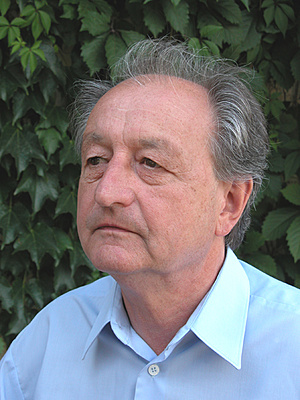
He was born in Győr on January 1, 1940. Between 1961 and 1966 he studied composition under Endre Szervánszky at the Liszt Ferenc Academy of Music, Budapest. In 1970 he founded the New Music Studio in Budapest, with Zoltán Jeney, Péter Eötvös, Albert Simon and László Vidovszky. In the mid-1970s he began formulating a special pedagogical and improvisation method called “Creative Music Practice” and gave many courses for music teachers in Japan, France, Italy, Belgium and Estonia. Since 1990 he has been Musical Director at the József Katona Theatre in Budapest and Professor of Music Performing Practice at the University of Drama and Film in Budapest. In 1996 he spent three months in Tokyo with a grant from the Japan Foundation, where he studied traditional Japanese theatre, music and dance. In 1998, his Studies for Steam Engines won 3rd prize in the 7th International Rostrum of Electroacoustic Music. Since that year he has been Member of the Széchenyi Academy of Letters and Arts.
His prizes and awards
Kassák Prize (1979); Erkel Prize (1985); Bartók–Pásztory Award (1993); Artist of Merit Award (2000)
 Deutsch
 English
 Español
 Français
 Magyar
 Polski
 Română
 Slovenský
 Slovenščina
 中文
中文