Deutsch
 English
 Español
 Français
 Magyar
 Polski
 Română
 Slovenský
 Slovenščina
 中文
中文音楽作品が作曲者から演奏者へ届くまで
楽譜出版社の使命は、紙媒体またはコンピュータ上の原稿を、演奏者にとって読みやすく、創造意欲をかき立て、使いやすい形に整えること、そして作品の普及、流通および適法な利用を確保することです。
75年にわたる経験を礎に、私たちはこの尊い仕事に思慮深く、献身的に、そして情熱をもって取り組んでいます。
作品を私たちに託してくださる作曲家および音楽教師の皆様に感謝申し上げます。
Márta, István
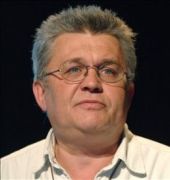 An experimental composer, Márta’s works employ technical procedures associated with repetitive music, and contain references to folk music as well as elements of the classical and light music traditions.
Biography
István Márta was born in Budapest, on 14 June, 1952. He studied composition with Rezső Sugár at the Budapest Academy of Music where he graduated, also with a teacher’s degree, in 1981. In 1976, he attended a composition course led by Witolt Lutosławski in Yugoslavia.
In 1973, Márta collected folksongs among the Hungarian Csángó ethnic group in Moldavia, Romania.
In 1972–76, he was leader of the musical section of the Young Artists’ club. In 1975–82, he led the Young Composers’ Club of the Association of Hungarian Musicians. In 1982–84, he headed the music section of the Council of Young Artists.
Between 1981 and 1983, Márta taught music history and 20th-century music analysis at the jazz faculty of the Béla Bartók Secondary School. In 1980–83, he was a member of Group 180, a Hungarian ensemble specialising in minimal and repetitive music. Since 1980, he has played and widely toured with the Mandel Quartet which performs both early and contemporary music.
In 1989 he founded the Kapolcs Days of Art, later renamed as the Valley of Art Festival, which became the largest multicultural festival in Hungary.
His prizes and awards
Prizes at the Tribune international des compositeurs, Paris (1981, 1987); Erkel Prize (1987); Golden Medal from the President of the Republic (1998); Knight’s Cross of the Order of the Hungarian Republic (2009); Officers’ Cross of the Order of the Hungarian Republic (2002); Middle Cross of the Order of the Hungarian Republic (2012)